
First Austrians
The Salzburgers in Ebenezer, Georgia
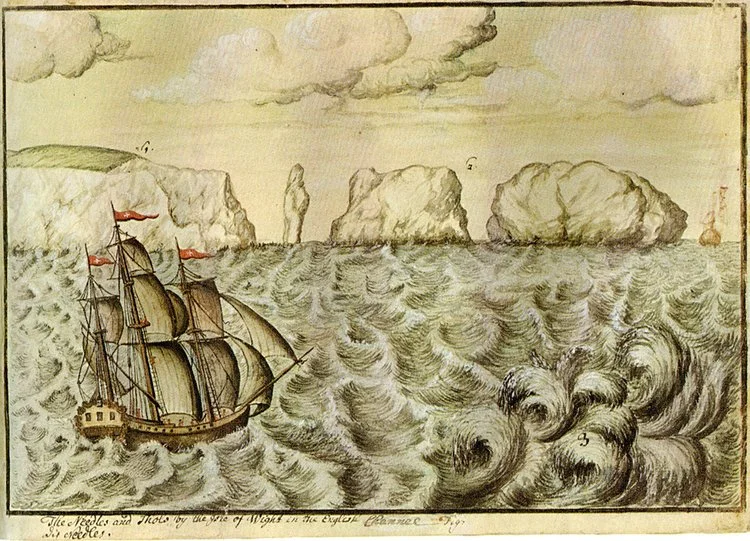
“The Needles”
Philip Georg Friedrich von Reck traveled with the Salzburgers to Gergia and documented their way to and in the New World. In this drawing, called “The Needles,” he depicted two ships, the Simonds and the London Merchant passing the Isle of Wright on their way to Georgia in 1735. The three large chalk cliffs can be seen in the background.
Expulsion
The history of colonial Georgia is often viewed through the lens of British expansion and the humanitarian visions of James Edward Oglethorpe. However, a significant and poignant chapter of this narrative belongs to a group of German-speaking Protestant refugees known as the Salzburgers. Their journey from the alpine valleys of Austria to the humid riverbanks of the American South remains a profound testament to religious conviction and the pursuit of a communal sanctuary.
It is important to note that Salzburg was an independent principality within the Holy Roman Empire at that time, as it had been for approximately 500 years, governed by the Prince-Archbishops who also constructed Hohensalzburg Castle, the city’s landmark. Salzburg only became part of Austria in the 19th century - long after the first Salzburgers had reached the shores of Georgia.
The genesis of the Salzburger migration lay in the religious intolerance of the early eighteenth century. In 1731, Archbishop Leopold Anton von Firmian issued the Edict of Expulsion, which mandated that all Protestants within the Archbishopric of Salzburg must either renounce their Lutheran faith or depart from their ancestral lands. Thousands chose the latter, embarking on a grueling journey across Europe. While many found temporary refuge in Prussia, a specific contingent sought a more permanent home in the fledgling colony of Georgia, facilitated by the Society for Promoting Christian Knowledge (SPCK) and the colonial trustees.
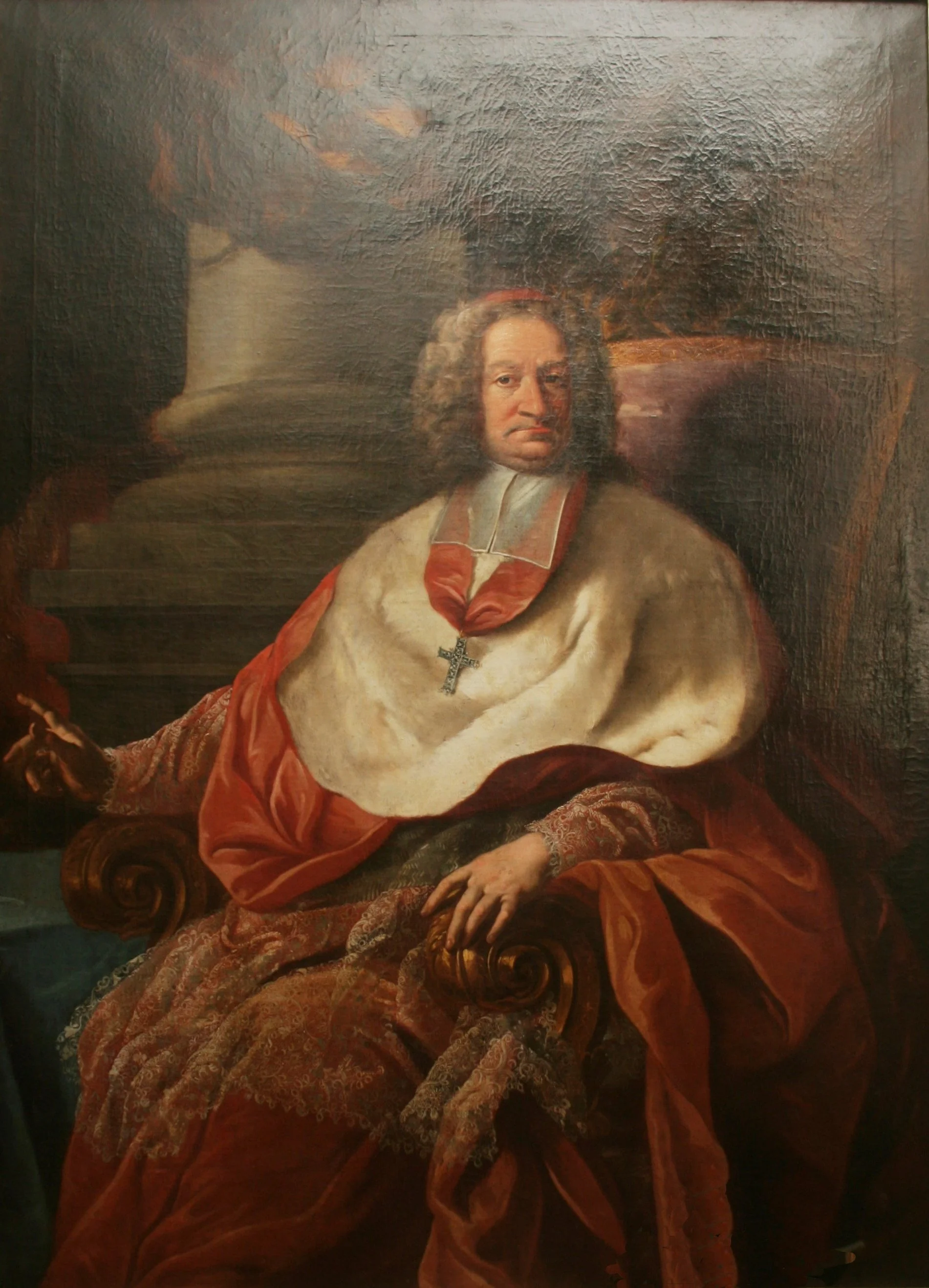
Leopold Anton von Firmian
Prince-Archbishop of Salzburg, expelled the Protestant Salzburgers.
Unknown painter/ Wikiemdia
Coming to America
Led by their devoted pastors, Johann Martin Boltzius and Israel Christian Gronau, the first transport of Salzburgers arrived at Savannah in March 1734. Oglethorpe received them with warmth and escorted them to a site approximately twenty-five miles upriver. They christened their new home Ebenezer, a name derived from the Hebrew for "Stone of Help," signifying their gratitude for divine providence.
The initial years were characterized by immense hardship. The site of "Old Ebenezer" was geographically isolated and proved to be poorly suited for agriculture. The swampy terrain bred disease, and the soil lacked the fertility required to sustain the community’s traditional farming methods. Despite these environmental adversities and a high mortality rate, the Salzburgers maintained a rigorous social and religious order, anchored by their Lutheran liturgy and a collective work ethic that distinguished them from other colonial settlements.
The Transition to New Ebenezer
By 1736, it became evident that the original location was untenable. After persistent petitions to Oglethorpe, the community was permitted to relocate to a more favorable site on a high bluff overlooking the Savannah River. This settlement, known as New Ebenezer, marked the beginning of a period of remarkable prosperity. The Salzburgers transformed the wilderness into a meticulously planned town, emphasizing industry and education. They are notably credited with establishing some of the first successful silk-production ventures in North America, as well as the first orphanage in the Georgia colony.
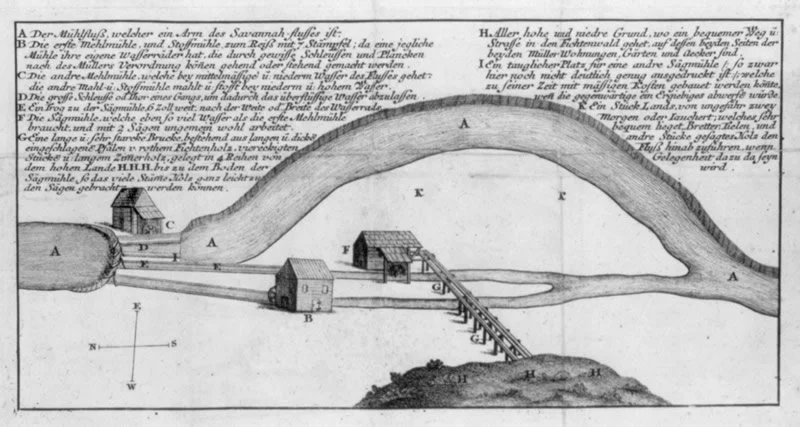
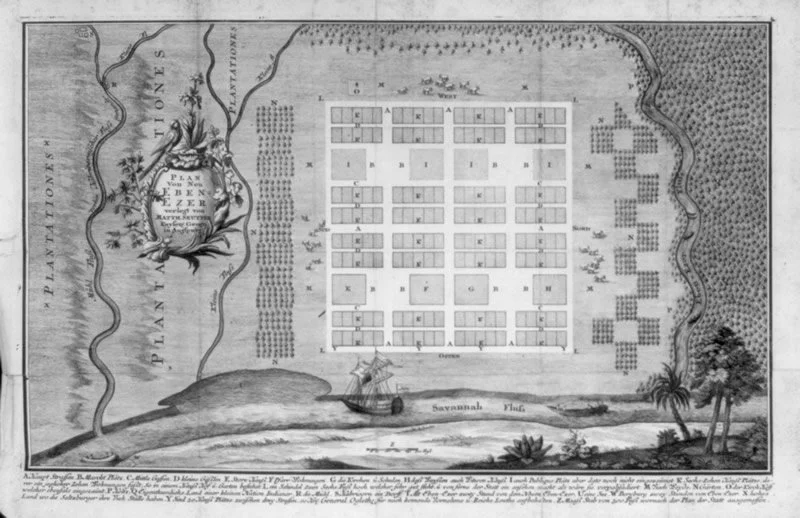
Above: Plan of New Ebenezer
Library of Congress
A Lasting Spiritual and Cultural Legacy
The enduring symbol of this resilient community is the Jerusalem Lutheran Church, completed in 1769 using bricks fired from local clay. It stands today as one of the oldest continuous worship spaces in the United States and serves as a physical reminder of the Salzburgers' commitment to their faith. Unlike many contemporary settlements that prioritized individual gain, Ebenezer was structured as a "theocratic" community where the church provided not only spiritual guidance but also the administrative framework for daily life
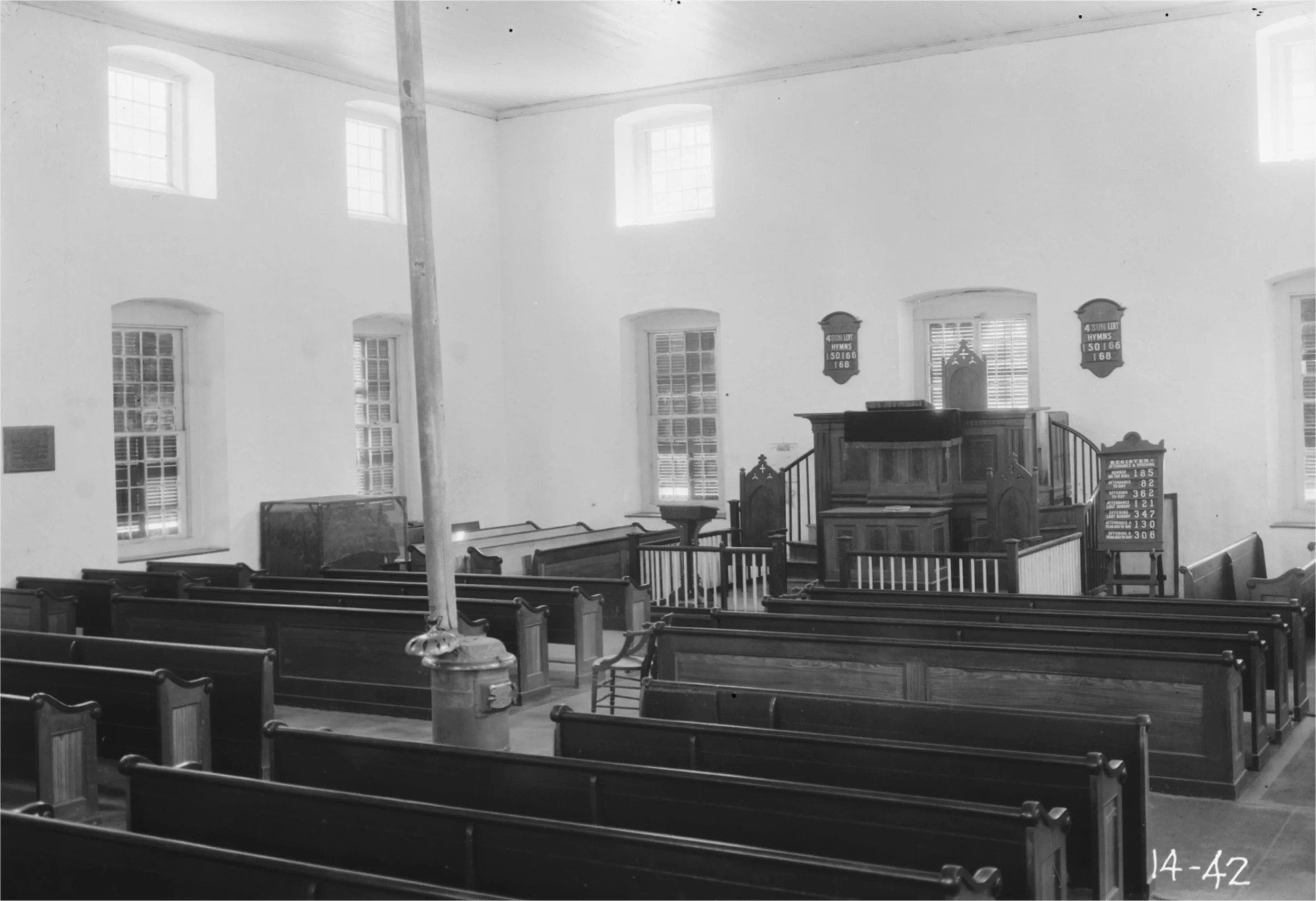

Above: Jerusalem Lutheran Chruch
Library of Congress
The Salzburgers’ contribution to Georgia extended beyond their economic success; they were vocal opponents of the introduction of slavery into the colony during its early years, arguing that it was contrary to Christian principles and the dignity of labor. While the American Revolution eventually brought disruption and damage to the town of Ebenezer, the descendants of these early pioneers preserved their heritage, ensuring that the story of their flight from persecution and their triumph in the wilderness remains a cornerstone of Georgia’s historical identity.
John Adam Treutlen (January 16, 1734 – March 1, 1782) is one example: the German-born member of the Salzburger community served as the first elected governor of Georgia after the adoption of the state's first constitution in 1777. Treutlen arrived as an indentured servant, working to pay for his family's passage. Intellectually gifted, he was invited by Pastor John Martin Boltzius to be educated at the Salzburger settlement in Ebenezer. Before entering politics, Treutlen became a successful schoolteacher, store owner, and wealthy planter in Effingham County.

John Adam Treutlen
Unknown painter
"Hitherto hath the Lord helped us." — The foundational sentiment of the Ebenezer community.